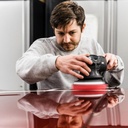
To get started in polishing, you need a 15 mm orbital polisher, about twenty pads, cutting and finishing polishes, a thickness gauge and an inspection lamp. At our shop's prices, this equipment comes to 950.36 € excl. VAT. Here is how to choose each item, and what you need to know before putting a pad on a customer's car.
The machine: a 15 mm orbital to start with
An orbital polisher combines a rotation and an orbit. The pad never stays in the same place: the heat is spread and the machine forgives a hesitant hand. A rotary turns on a single axis. It corrects faster, and it burns a clear coat in a few seconds in a beginner's hands. Keep it for later.
A 15 mm orbit gives enough throw to correct bodywork and stays gentle when finishing. Our shop offers the Liquid Elements T4000 V2 MK2 at 227.27 € excl. VAT. Its data sheet states 950 watts, a speed adjustable from 2,000 to 5,000 revolutions per minute, a 125 mm backing plate already fitted, a weight of 2.7 kg and an 8-metre cable. The machine comes with a spare pair of carbon brushes.
A 125 mm backing plate covers the large panels: bonnet, roof, doors, wings. The pillars and the narrow areas need a smaller machine. It can wait for your first cars.
Pads: four to six per step
A pad loads up with polish and removed clear coat. After two or three panels, it no longer cuts and it heats up. Plan four to six pads per polishing step for a whole car. Clean each pad with a brush or compressed air after each panel.
Two families are enough to start with. Cutting pads, in firm foam, remove scratches. Finishing pads, in soft foam, bring back the gloss. Each pad stays paired with a single polish. A finishing pad that has received a cutting polish leaves a haze on the paint.
The Cartec Refinish 150 mm starter kit settles the question. It contains 20 pads for eccentric machines, five per colour, and six microfibres. Cartec matches a pad colour to each polish in its range: you mix nothing up. Wash the pads after each car and let them dry flat.
Polishes: one for cutting, one for finishing
A cutting polish contains abrasives that remove a thin layer of clear coat, and the scratches with it. It leaves a slight haze. A finishing polish, which is finer, removes this haze and brings back the depth. A two-step polishing uses the two products one after the other. A one-step polishing uses a single polish, which corrects less.
The Refinish kit contains four one-litre polishes, from the most abrasive to the finest: Diamond Cut 3000, Compound 5000, Final Cut 9000 and Ultra Finish 12000. A carnauba wax and a Panel Spray degreaser complete it. A wall rack holds the set. The kit costs 495.90 € excl. VAT.
The degreaser is used between two steps. The oils in a polish mask the defects that remain. A pass of Panel Spray removes them and shows the real result. The wax protects the paint once polishing is finished.
Always start with the mildest combination. If the defect remains, move up to the next pad or polish. Clear coat that has been removed does not come back.
Checking: the gauge before, the lamp during
The thickness gauge comes first. It measures the paint thickness on each panel. A value clearly higher than on the rest of the car indicates a repainted area. A lower value indicates a clear coat that has already been worn down. In both cases, you soften the combination or give up cutting. The NexDiag NexPTG costs 144.63 € excl. VAT in our shop.
The test spot comes next: 30 cm by 30 cm, with the mildest combination. Check under the lamp. Step up the combination only if the defect remains. The validated combination is then used for the whole car.
The inspection lamp shows what ceiling lighting hides: micro-scratches and holograms. A hand lamp is enough to start with. The Scangrip Minimatch costs 82.56 € excl. VAT.
Before polishing, mask the seals and the bare plastics with masking tape. Keep away from the edges: the clear coat is thinner there.
The starting budget, item by item
| Item | Product | Price excl. VAT |
|---|---|---|
| Machine | Liquid Elements T4000 V2 MK2, 15 mm orbital | 227,27 € |
| Polishes, pads, degreaser, microfibres | Cartec Refinish 150 mm starter kit | 495,90 € |
| Thickness gauge | NexDiag NexPTG | 144,63 € |
| Inspection lamp | Scangrip Minimatch | 82,56 € |
| Total | 950,36 € |
Also plan for: masking tape and a pad brush.
The Liquid Elements A1000 V4 cordless mini polisher costs 202.48 € excl. VAT. With it, the total comes to 1 152.84 €. Buy it when the pillars and the narrow areas are costing you time.
These prices exclude VAT. Your VAT scheme changes the real cost of the equipment: we compare the exemption scheme and the standard scheme in Getting started in detailing in Belgium.
What the equipment does not solve
Paint is polished clean. Washing and decontamination come before the machine. Otherwise, the pad drags grains across the clear coat.
Allow for the time too. In our workshop, polishing in one step takes one day, polishing in two steps two days, a full correction three days. Your first cars will take longer. Quote a lead time you will keep.
Beginner mistakes look alike from one trainee to the next: a saturated pad kept for the whole car, polishing started without a test spot. We describe them in the five mistakes we correct on the first day of training.
Where to train before buying
Try a machine before paying for it. Our Introduction to detailing lasts one day in Wavre, with eight trainees at most. On the programme: washing method, decontamination, inspection under the lamp, clear coat measurement, first machine polishing. It costs 295 € incl. VAT, equipment and products provided.
The Advanced course lasts five days and costs 2 950 € incl. VAT. It covers multi-step polishing, ceramic coating, the interior and the organisation of a workshop. It is aimed at those who want to make it their trade.
We have already trained for the Forem, the CPAS social welfare centres and Territoire Zéro Chômeur. If you are looking for a job, talk to your adviser before registering.
In the shop
- Liquid Elements T4000 V2 MK2, 15 mm orbital polisher : 227,27 €
- Cartec Refinish, starter kit for 150 mm eccentric polishing : 495,90 €
- NexDiag NexPTG, thickness gauge : 144,63 €
Prices excl. VAT.
Frequently asked questions
Which polisher should you choose to get started in polishing?
An orbital polisher with a 15 mm orbit and a 125 mm backing plate. It spreads the heat and tolerates a hesitant hand. The rotary can wait until your technique is sure.
How many pads do you need to polish a car?
Four to six per polishing step, cleaned after each panel. A two-step polishing therefore needs eight to twelve pads.
What budget should you plan to get started in polishing?
950.36 € excl. VAT at our shop's prices: orbital polisher, polish and pad kit, thickness gauge, inspection lamp. The cordless mini polisher adds 202.48 €.
Do you need a thickness gauge to polish?
Yes, as soon as you polish a customer's car. Without a measurement, you do not know whether a panel has been repainted or whether its clear coat is already thin.
Can you polish with a single polish?
Yes, for a one-step polishing: a single product cuts and finishes. The correction remains more limited than in two steps.
Nathan Fougnies, founder of Ultimate Care, Wavre